
Spectral analyses provide information about mine water quality
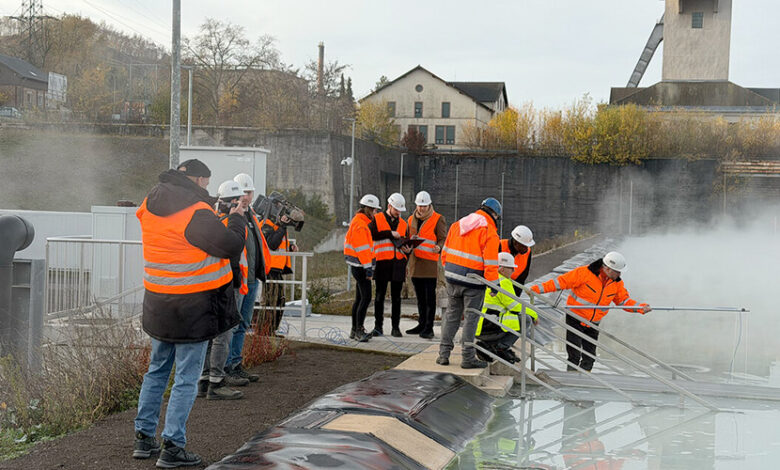
International start-up tests innovative process in Camphausen as part of the BRYCK WaterHub. SpectroMarine’s expertise and technology will enable real-time analyses in the future.
The collaboration between RAG Aktiengesellschaft, Essen/Germany, start-ups and the BRYCK start-up and innovation centre is entering its next practical phase. While Dutch start-up Acquaint is testing an innovative inspection system for shaft pipelines in the Ruhr area, the focus in Saarland is now on real-time analysis of mine water. The Latvian-Dutch start-up SpectroMarine is providing the technology and expertise for the pilot project at RAG’s Camphausen site in Quierschied/Germany. Whether and how the innovative process proves itself will become clear over the next six months.
Until now, only a few parameters of mine water could be reliably measured on site. For many, there are no immediate results. The mine water must first be sent to a laboratory for analysis. This takes time. SpectroMarine wants to change this and also enable continuous, automatic monitoring directly on site. To this end, the start-up is using intelligent sensor systems with optical measurement technology. With the help of spectral analyses, it should be possible to detect in real time whether the water quality is changing.
So far, the sensors have been used successfully in the inflow of seawater desalination plants. In the first two months of pilot operation, SpectroMarine now wants to prove that the technology also works with the special mine water from the Camphausen central water management system. Based on this, the start-up is testing whether the sulphide content can be determined directly at the shaft. This would be important for controlling the hydrogen peroxide plant and avoiding unnecessary overdosing. Comparative data is provided by the ‘traditional’ RAG water analyses, which continue to be carried out regularly in parallel. If the test phase is successful, the plans envisage a gradual expansion to other RAG sites and measuring points.
To mark the start of the pilot operation, representatives from RAG, SpectroMarine and BRYCK met at the Camphausen mine water treatment plant on 13 November 2025. Openness, partnership and a drive to implement characterised the work on installing the analysis prototype. All sides were enthusiastic about developing solutions. Saarländischer Rundfunk accompanied the kick-off. Speaking to the media representatives, Svenja Weinand from RAG’s Mine Water Planning/Concepts department (T-WH-GK) emphasised the importance of real-time water analysis: “When a full analysis of the water is carried out, a sampler has to go to the sampling point, transfer the water into sample bottles and take it to the laboratory. There it is analysed. Then the data has to come back to us.” Depending on the scope of the analysis, this can take anywhere from a few days to a few weeks. Only with live values can RAG react quickly to changes in mine water.
With regard to the cooperation between RAG, BRYCK and start-ups, Torben Stallmann, BRYCK WaterHub, says: “When we talk about innovation in the water sector, this is exactly what we mean: recognising potential, enabling it and finally implementing it. Together with RAG, the start-up and our team at WaterHub, we are creating the conditions under which new solutions for the water world can emerge – step by step, very close to practical application.”
