Technische Hochschule Georg Agricola

  • THGA launches partnership with Moroccan preparatory college

    A new partnership is providing targeted preparation for prospective students wishing to undertake a Bachelor’s degree in Bochum: THGA is launching a collaboration with the Moroccan organisation Study in Germany (SIG) to help prospective students prepare for their studies.

    The Georg Agricola University of Applied Sciences (THGA) in Bochum/Germany is continuing to expand its international partnerships. The university is launching a collaboration with the Moroccan organisation Study in Germany (SIG), which is designed to prepare prospective students specifically for a Bachelor’s degree programme at THGA. To mark the official launch of the collaboration, University President Prof. Susanne Lengyel recently welcomed a delegation from SIG to the campus in Bochum.

    During their visit, Managing Director Rachid El Boury and staff member Hicham Chakir familiarised themselves with the university, its laboratories and study conditions. The agenda also included discussions on the requirements for studying in Germany and the further development of the joint collaboration. The aim is to prepare prospective students as effectively as possible, whilst still in Morocco, for the start of their studies in Bochum.
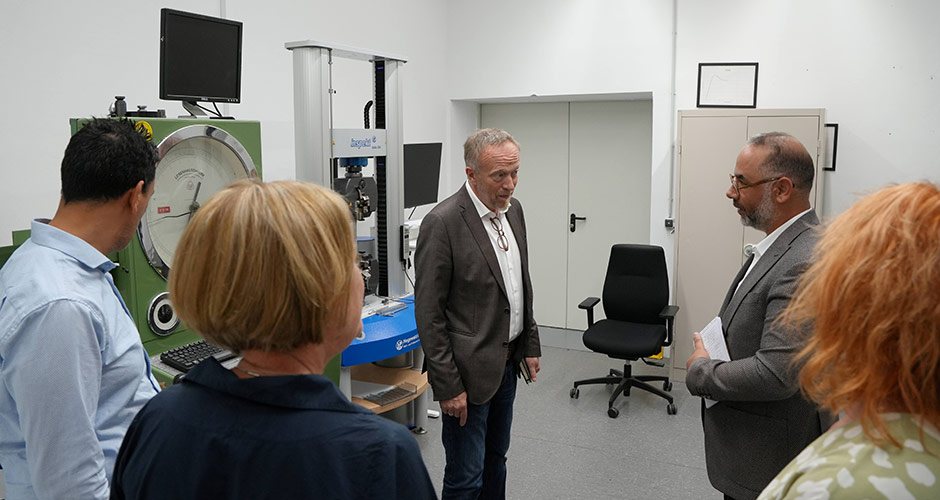
    Discussion on study conditions at the THGA. Photo: THGA

    “International students have been enriching our university for many years. That is why we want to continue attracting young people from all over the world to study at the THGA. As well as the number of international students, our primary focus is on the quality of the support we provide. The better prospective students are prepared for their studies, both linguistically and academically, and the more realistic their expectations of life and learning in Germany are, the greater their chances of a successful academic career,” says University President Prof. Susanne Lengyel.

    Working together to enhance academic success
    The cooperation centres on selected German-language Bachelor’s degree programmes at the THGA. The SIG supports prospective students even before they arrive in Germany with a comprehensive preparatory programme. As well as improving their German language skills, participants acquire a foundation in their subject area and familiarise themselves with the German higher education system, study methods and everyday student life. Cultural and organisational aspects of life in Germany are also covered. This helps students form a realistic figure at an early stage of what studying at a German university entails.

    With this approach, the THGA is pursuing a clear goal: international students should not only find their way to Bochum, but also study successfully here and complete their degree. The partnership with the SIG is therefore part of a long-term internationalisation strategy that focuses on rigorous selection, effective support and sustainable academic success.
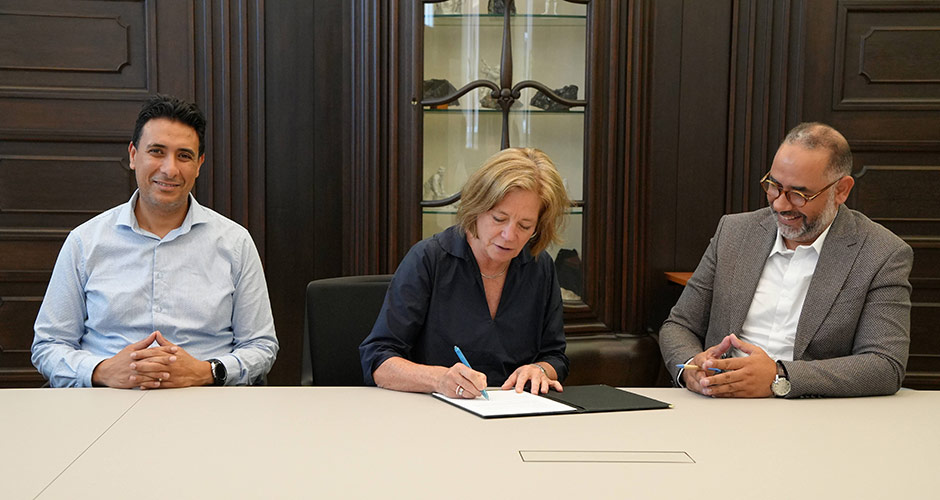
    Signing of the collaboration agreement between the THGA and SIG. Photo: THGA

    Practice-oriented degree programmes prove their worth
    Managing Director Rachid El Boury sees great potential for young people in Morocco: “Studying at the THGA combines academic excellence with a strong practical focus. It is precisely this that makes the engineering degree programmes particularly attractive to many of our pupils.”

    The SIG currently operates six centres in Rabat, Casablanca, Fez, Agadir, Tangier and Kenitra, where it prepares several hundred prospective students each year for a degree in Germany. Around 70 per cent of the preparatory courses have a technical focus. The high level of interest shown by young women in technical degree programmes is particularly encouraging. “We have many highly educated women who can envisage studying engineering in Germany,” says El Boury.

    Two long-established educational partners
    For the managing director, the partnership also holds special symbolic significance: “Germany’s oldest university of engineering will in future be collaborating with an institution based in the oldest building in the Moroccan capital, Rabat. This is a wonderful symbol of the bond between our two countries.”

    Next steps in the collaboration
    The next phase of the collaboration now begins with a face-to-face meeting on campus. Both partners have agreed to exchange detailed information in future on course content, modules and areas of academic interest, in order to provide prospective students with even more targeted advice. The SIG will play an active role in this, including through explanatory videos and close, personalised academic guidance, to ensure that expectations and the reality of university life align as closely as possible – because the better the preparation, the higher the success rate in studies. In addition, Moroccan students from the THGA community are to be involved as role models. A return visit is already planned: the President and Vice-President of the THGA will visit the SIG in Rabat. (THGA/MRG)
  • Second Research Symposium of Bochum’s Universities of Applied Sciences boosts interdisciplinary exchange at the THGA

    Following its successful debut in 2024, the research symposium organised by Bochum’s Universities of Applied Sciences (HAW) is now in its second year. This year, the Georg Agricola University of Applied Sciences (THGA) hosted the event under the motto ‘Research connects – Shaping the future with knowledge’, with the aim of specifically strengthening academic exchange across disciplinary and institutional boundaries. This well-established event provided a central platform for Bochum’s HAWs to raise the profile of applied research across its full spectrum, to network valuable expertise within the region, and to provide new impetus for the future. Not only did it highlight the wide range of topics and innovative strength of the participating institutions, but it also specifically identified common ground in terms of content and methodology.

    “Research at our universities thrives on direct transfer into practice and the courage to develop genuine innovative strength by working in close collaboration,” said Prof. Susanne Lengyel, President of the THGA, as she welcomed the guests. “The symposium impressively demonstrates that we can only answer the pressing questions of our time – from the energy transition to digital transformation – if we look beyond our own horizons. As hosts, we look forward to bringing together bright minds and acting as a driving force for innovation in Bochum and the region.”

    The varied agenda offered the more than 150 participants not only specialist presentations but also political and strategic insights into the research landscape. In the morning session, Jagoda Josch (adviser and coordinator for Science and the City of Bochum) and Andrea Kienle (Head of the Research Department at the Ministry of Culture and Science) highlighted the importance of HAW research for urban society and the state of North Rhine-Westphalia.

    Jagoda Josch emphasised how closely science and the city depend on one another to take up new ideas and put them into practice. “Research brings curious people together,” she said, highlighting the driving force and added value of scientific collaboration across institutional and societal boundaries.

    Andrea Kienle contextualised the development of HAW research in North Rhine-Westphalia within the framework of higher education policy and highlighted just how dynamically research at universities of applied sciences has evolved in recent years. At the same time, she encouraged researchers to consider even challenging funding opportunities, such as DFG grant applications.

    In the subsequent academic sessions, researchers presented current projects from the forward-looking clusters ‘Resources & Sustainability’, ‘Social Affairs & Health’ and ‘Computer Science & Data Science’

    The fact that this year’s event has demonstrated a significantly enhanced structure and level of professionalism is also reflected in the academic documentation: For the first time, a dedicated abstract volume with an official ISBN number is being published to accompany the event, edited by Bochum University of Applied Sciences.

    Prof. Michael Prange, Vice-President for Research, Development and Transfer at THGA, sees this consistent development as confirmation that the institution is on the right track: “Our research has gained enormously in depth and relevance in recent years, driven not least by our right to award doctorates through the NRW Doctoral College. With this second symposium, we are establishing a genuine powerhouse of networking. We are defining the format much more clearly, ensuring the programme items are more closely interlinked, and actively fostering new collaborations – which is precisely why we have also integrated formats such as Science Speed Dating this year.”

    A central highlight and the tangible embodiment of the guiding principle ‘Research Connects’ was the extensive poster session in the afternoon. Researchers at all stages of their careers presented their projects across a total of 60 posters. The spectrum ranged from health and social research, through sustainability and mobility topics, to computer science, robotics and applied technologies. It was here in particular that it became clear just how different the individual projects are in detail – and yet how many surprising connections, both in terms of content and methodology, exist between them. The poster session provided the ideal setting for in-depth discussion and new collaborations.

    The following were awarded the prize for best scientific posters of 2026:

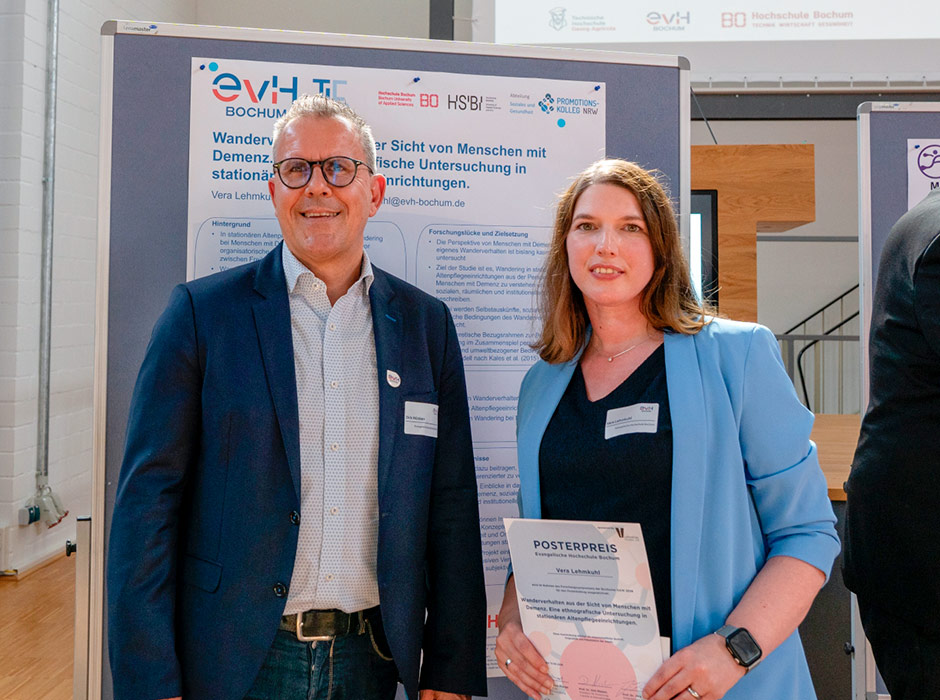
    • Vera Lehmkuhl (EvH): Wanderverhalten aus der Sicht von Menschen mit Demenz. Eine ethnografische Untersuchung in stationären Altenpflegeeinrichtungen. [Wandering behaviour from the perspective of people with dementia. An ethnographic study in residential care homes for the elderly.]
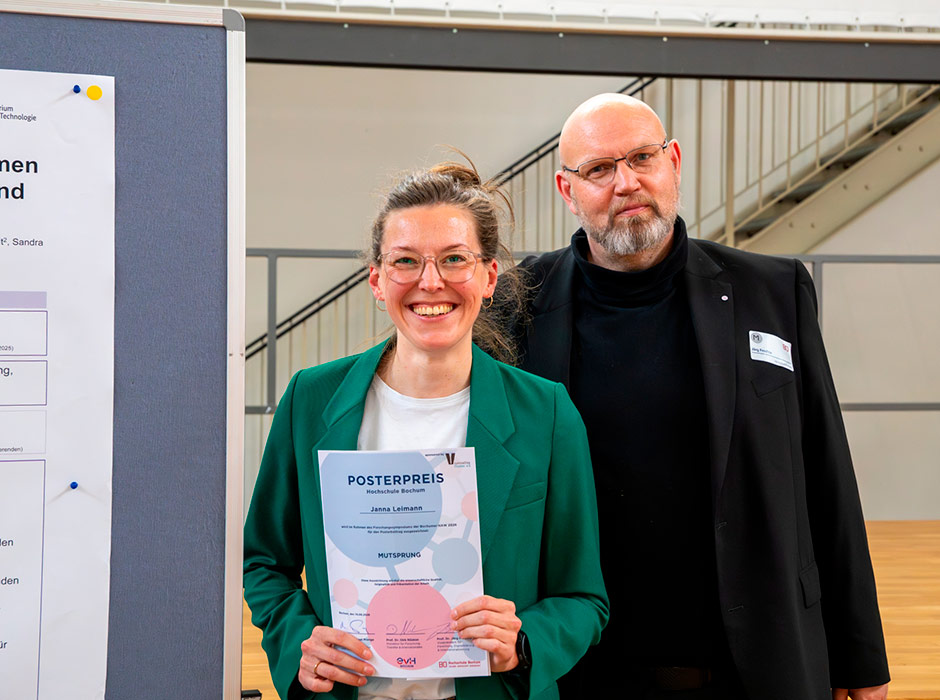
    • Janna Leimann (HSBO): MUTSPRUNG.
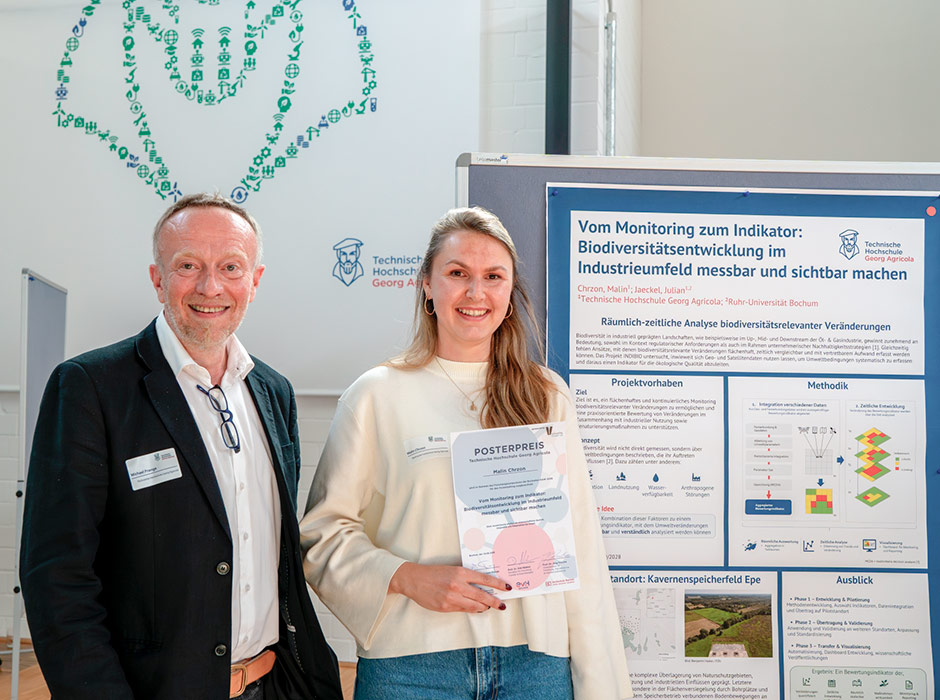
    • Malin Chrzon (THGA): Vom Monitoring zum Indikator: Biodiversitätsentwicklung im Industrieumfeld messbar und sichtbar machen. [From monitoring to indicators: making biodiversity trends in industrial settings measurable and visible.]
    Award winner Vera Lehmkuhl (EvH)
    and Prof. Dirk Nüsken (EvH).
    Photo: THGA
    Award winner Janna Leimann (HSBO)
    and Prof. Michael Prange (THGA).
    Photo: THGA
    Award winner Malin Chrzon (THGA)
    and Prof. Jörg Frochte (HS Bochum).
    Photo: THGA
  • THGA further develops its university structure and reorganises its governance

    The TH Georg Agricola University (THGA), Bochum/Germany, is realigning its university structure and, to this end, elected two new academic vice-presidents and the head of the Rese-arch Center of Post-Mining (FZN) at the university’s electoral assembly on 20 May 2026.

    Prof. Ludger Rattmann was elected as Vice-President for Studies and Teaching, and Prof. Michael Prange as Vice-President for Research, Development and Transfer. Prof. Christian Melchers was confirmed as head of the FZN.

    With this election, THGA is launching a comprehensive organisational development process aimed at restructuring the university’s management structures and decision-making processes. As the only engineering university in the Ruhr region, the THGA combines a long tradition of imparting engineering expertise with a clear focus on major societal challenges such as the energy transition and climate change.
    Until now, the university’s academic vice-presidents were also responsible for leading the academic departments. In future, these roles are to be separated organisationally. At the same time, the Executive Board will be streamlined: instead of three, the university will in future work with two academic vice-presidents. The THGA is thus pursuing the aim of more clearly separating strategic management, governance and operational responsibility.

    “With these decisions, the THGA is setting an important course for its future development. The University Council expressly welcomes the fact that the university is further developing its structures whilst consistently strengthening its academic profile in the fields of georesources, post-mining and transformation,” explains Bärbel Bergerhoff-Wodopia, Chair of the University Council and member of the Executive Board of the RAG-Stiftung.

    “I am delighted that we can now jointly launch this important development process for the THGA. I warmly congratulate the elected Vice-Presidents and very much look forward to working with them,” says THGA President Prof. Susanne Lengyel, “At the same time, I would like to express my sincere thanks to Prof. Michael Bendrat, who has held the office of Vice-President for many years with great dedication, for his exceptional commitment to our university. He has made a significant contribution to ensuring that our practice-oriented engineering education enjoys an excellent reputation among companies and partners.”
    During a transitional phase, the two newly elected Vice-Presidents will continue to take on the additional responsibility of leading one academic division each. In summer 2026, the first independent head of a research division will be elected. By 2029 at the latest, all research divisions are to be managed independently of the Executive Board. The aim is to strengthen the organisational structure of the academic divisions, to structure decisionmaking processes more clearly and to enable greater participation within the university.

    The THGA’s Research Center of Post-Mining is also undergoing a process of change: the facility will be further developed into the Transformation Center for Georesources and Ecology (TGÖ) by 2028. The aim is to strategically expand the THGA’s research activities in the fields of georesources, post-mining, the environment and transformation, and to place the focus on interdisciplinary research.
    With these two development processes, the THGA is responding to the growing demands placed on universities in the areas of research transfer and modern university governance. It regards these as key prerequisites for further developing its position as a practice-oriented engineering university in the Ruhr region in the long term. (THGA/MRG)

  • Nachbergbauzeit NRW 2025: Conference highlights the potential of digitalisation for post-mining

    The question of how sustainable digitalisation can be achieved in post-mining was the focus of the symposium “Nachbergbauzeit NRW 2025 – Digitalisation meets tradition” held on 20th March 2025 at the Student Centre of the TH Georg Agricola University (THGA) in Bochum/Germany (Figure 1). Around 250 participants were able to experience in a variety of presentations and direct exchanges how much and what is already technically possible and successfully in use. The post-mining era in North Rhine-Westphalia thus built a thematic bridge from the traditional and historically immensely influential mining industry to the future and to state-of-the-art digital technologies.

    Organised by the Research Center of Post-Mining (FZN) and the Department of Mining and Energy of the Arnsberg District Government, the event offered a nationally and internationally unique platform to show how digitalisation and traditional methods work together to sustainably master the challenges of post-mining.

    The open and technically diverse structure of the post-mining era in North Rhine-Westphalia was addressed right at the start of the conference. In his welcome address, Prof. Christian Melchers, head of the FZN, aptly stated in line with the conference motto: “We have a treasure in the Ruhr region. And it is no longer hard coal. It is data.” Prof. ­Melchers not only emphasised the high value of geodata and the opportunities its digitalisation offers us, but also ventured a positive regional outlook for the coming decades: “The Ruhr region has the opportunity to become the greenest industrial region in the world!”

    Post-mining is more than a regional issue – it is a project for the future with global relevance. Prof. Susanne Lengyel, President of the THGA, made this unmistakably clear. Her focus is on the young professionals who will help shape this change. “Together with our students and future graduates, we want to tackle the tasks that post-mining in particular brings with it,” emphasised Lengyel. For her, one thing is certain: cutting-edge research alone is not enough. We need people who are willing to take responsibility and break new ground. “The demand for raw materials is growing worldwide. We need to deal with this in a sustainable and responsible manner. These are all important issues that will occupy us today – and in the future.”

    Heinrich Böckelühr, District President of the Arnsberg District Government, followed with a brief insight into the historical dimension of mining, the development of post-mining in North Rhine-Westphalia and the resulting challenges. He emphasised the importance of the Post-Mining Period in North Rhine-Westphalia, which is now taking place for the eighth time, describing it as a “genuine traditional event”. Heinrich Böckelühr also pointed out the enormous opportunities offered by digital technologies, e. g. in hazard prevention. According to the District President, the further digitalisation of the mining authority is indispensable and remains a key priority.

    Bärbel Bergerhoff-Wodopia, member of the Executive Board of the RAG-Stiftung, spoke in her speech about sustainable financing and coping with perpetual obligations after the end of German coal mining. She particularly highlighted the FZN’s path to becoming a transformation centre for georesources and ecology (TGÖ). This development is a decisive step towards linking science, transfer and innovation more closely and providing forward-looking impetus for the sustainable use of georesources. Bergerhoff-Wodopia: “We are committed to supporting and accompanying the TGÖ on its journey, because we are certain that knowledge creates the basis for shaping a sustainable and liveable future!”

    North Rhine-Westphalia, once an important mining region, has long since developed into a post-mining region. Today, the region uses its extensive experience and innovative knowledge to record and manage the traces of intensive raw material extraction. The symposium impressively demonstrated how historical legacy data and modern geodata can be combined to promote the sustainable management of post-mining landscapes.

    The use of drones in post-mining, 3D modelling, improvements in digital maps for risk management, automation in geomonitoring, digitised water management, the use of AI and open data systems: the speakers were able to shed light on post-mining from a variety of topics and perspectives, visualise science in their presentations and explore potential.

    The combination of lectures, discussions and networking opportunities, as well as the multi-perspective approach to the topic, once again proved to be a great asset to the eighth Post-Mining Period, as Prof. Melchers noted: “The Nachbergbauzeit NRW 2025 was a complete success. The concept has once again proven its worth. Comprehensive content, interesting presentations and great encounters already have me looking forward to the next Nachbergbauzeit NRW 2027.” (THGA/Si.)

  • The best thesis at the conference: THGA student receives the Oskar-Niemczyk prize in Austria

    How can the world power itself in the long term? And how can we make sustainable use of raw materials in the future? Experts frequently exchange ideas on these topics at the “Mining, Energy and Raw Materials” conference held by the Deutscher Mark­scheider-Verein (DMV). This year, the conference took place at the Montan­universität Leoben in Austria. Specialists from the TH Georg Agricola (THGA) University of Applied Sciences, Bochum/Germany, also take advantage of this forum to discuss issues with other industry experts. Stefan Schnell, graduate from the professional Master’s course “Geological Engineering and Post-Mining” offered by the THGA, was awarded the Oskar Niemczyk prize for his innovative monitoring system “Mineberry” (Figure 1). The conference will come to Bochum and the THGA for the first time in 2019.
    Stefan Schnell’s concept was able to win over the expert jury: For his Master’s thesis, this 37 year old developed a monitoring system that can control the surface openings of former mining operations. Openings of this kind left over from mining operations near to the surface, sometimes centuries old, are particularly prevalent in the southern Ruhr region. Stefan Schnell’s employer, RAG Aktiengesellschaft, is monitoring around 4,000 old shafts in this area. Approximately 20 of these shafts are repaired each year. “The large number of legacies means that not all properties can be completely overhauled with immediate effect, so monitoring technologies are required on a transitional basis,” explains Stefan Schnell, referring to his idea, developed in conjunction with a number of electrical engineers at the THGA. The sensors on his Mineberry detect the smallest changes or ground motion at the surface. “If anything subsides, the responsible engineer immediately receives a live image on their mobile. Everything is powered by environmentally-friendly solar cells.” The guide in Stefan Schnell’s Master’s thesis will serve as the groundwork for the implementation of such monitoring systems in future. (THGA/Si.)

  • Mining and Water Forum: Christian Melchers from THGA has joined the new board of expert trustees

    What happens when miners leave and water comes in? What do you have to watch out for to ensure nature and the environment are not affected negatively? The independent “Mining and Water Forum” trust foundation, which has started up in Essen/Germany (Figure 1), is dedicated to answering questions like these concerning mine water plans. The board of trustees, composed of international experts, aims to investigate the risks and opportunities arising from them – and includes Prof. Christian Melchers, scientific director at the Research Institute of Post-Mining at Georg Agricola Technical University (THGA) in Bochum/Germany, who has been appointed deputy chairman. The findings should help to optimise previous mine water plans for the coal fields in the Ruhr, Saar and Ibbenbüren regions on a sustainable basis. RAG Aktiengesellschaft is supporting the foundation by providing 5 m e over the next five years.

    After the last ton of German coal has been brought to the surface at the end of 2018, the aim is for the mine water to rise to a level that will not have a negative impact on the environment. The existing plans have allowed for this. However, critics fear there may be negative effects on drinking water and the environment. According to Prof. Melchers, the discussion shows that there is room to optimise the rise in mine water levels, which could be resolved by further research.

    To carry out this research, the foundation has appointed six recognised international experts in hydrogeology – the science of water in the earth’s crust – and mine water to its board of trustees. “We are independent and carry out research for practical applications. Our research results should contribute to developing economically and ecologically sustainable solutions for people and nature,” says chairman Prof. Josef Klostermann, the former director of the North-Rhine-Westphalian Geological Service.

    The foundation carries out its own research projects, but also funds third-party projects, explains Prof. Melchers: “Fundamental and applied research is supported. We welcome initiatives from expert groups and the interested public.” A major dialogue event is set to take place later this year as a result. Any interested citizens, authorities or political bodies can participate and contribute their own ideas in order to identify the challenges faced. “In addition, these events aim to help clarify the complex associations of rising mine water levels and therefore to increase acceptance in society.”

    The independence of the new foundation is guaranteed. RAG, as a backer, cannot have any influence on the organisation’s work. This is monitored by the foundations association (Stifterverband), which manages the assets. In addition, RAG has committed to taking the experts’ suggestions into account in its mine water plans and to put them into practice.

    Besides Prof. Melchers and Prof. Klostermann, the experts of the “Mining and Water Forum” include Prof. Maria-Theresia Schafmeister from the University of Greifswald/Germany, Prof. Christian Wolkersdorfer from the Tshwane University of Technology in Pretoria/South Africa, Prof. Sylke Hilberg from the University of Salzburg/Austria, Prof. Georg Wieber from the University of Mainz/Germany and Rainer Lüdtke, who coordinates the non-profit-making trust foundation for the foundations association. (THGA/Si.)

  • Marketing rare earths: Georg Agricola Technical University receives funding for an international research project

    “Rare earths” are an essential part of modern technology. These metals – which, despite their name, are not actually very rare – are used in a large number of high-tech applications, including high-performance magnets that can be found e. g. in wind turbine generators or electric car engines. The market is currently dominated by Chinese producers. A German-Brazilian research project wants to offer an alternative. Under the “Rare Earth Global Industry and New Application” (REGINA) project, industrial engineering expert Prof. Alfred Niski from Georg Agricola Technical University (THGA) in Bochum/Germany is investigating marketing opportunities (Figure 1). The Federal Ministry of Education and Research (BMBF) is donating around 280,000 € to fund Prof. Niski’s research over the next three years.

    “At the moment, China is a quasi-monopolist for rare earths and also dominates the market for products based on them, such as high-performance magnets,” says Prof. Niski. “Its market-dominating position means it can dictate the prices, which can put industrial customers in Germany, e. g., at a disadvantage. In addition, environmental and social standards are often not adhered to in Chinese production. In applications such as electromobility or regenerative energy production this is simply unacceptable.” However, REGINA is focussing on the emerging market of Brazil. With around 22 mt, it has the second-largest reserves of rare earth metals in the world (China: 55 mt). Eight partners from Germany and Brazil – four universities, three non-university research institutes and one raw materials company – want to support the development of Brazilian reserves locally in the joint research project, and to optimise the entire value chain from the processing of raw materials to their use in high-tech products.

    The team of researchers under Prof. Niski at THGA will firstly investigate the market for rare earth-based high-performance magnets and compare it against a strength/weakness analysis of Brazilian production. Taking this as a basis, the Bochum-based industrial engineers will then develop strategies and concrete business models, taking into account the political aspects of raw materials. The aim is to establish Brazil as the second noteworthy supplier of rare earths in Germany. “Rare earths are a key factor in the supply of raw materials in Germany,” says Prof. Niski. “It is important that German companies do not make themselves unilaterally dependent on China, but have alternatives in the form of Brazilian suppliers. I hope that, with our work, we can contribute to greater sustainability from an ecological, economic and social perspective. The aim should be for rare earth products to be produced in a fairer, cleaner way than in the past.”

    More support is currently being sought for Prof. Niski’s project team: Master’s graduates in technical business management or industrial engineering can apply to Prof. Niski for a position as a research associate. There is also the opportunity to pursue doctoral studies.

    The following institutions and companies are participating in REGINA:

    • Fraunhofer Institute for Silicate Research ISC/Fraunhofer Project Group for Materials Recycling and Resource Strategies IWKS;
    • Darmstadt Technical University;
    • Helmholtz Institute Freiberg for Resource Technology;
    • Clausthal Technical University;
    • Georg Agricola Technical University;
    • CERTI Centros de Referência em Tecnologias Inovadoras (Centers of Reference in Innovative Technologies, Florianópolis, Brazil);
    • Universidade Federal de Santa Catarina (Santa Catarina University, Florianópolis, Brazil); and
    • Companhia Brasileira de Metalurgia e Mineração (CBMM), Araxá, Brazil.

    REGINA is supported by the BMBF under the “CLIENT II – International Partnerships for Sustainable Innovations” funding scheme within the “FONA – Research for Sustainable Development” framework funding programme. (THGA/Si.)

  • THGA

    Marcus Plien, Lecturer at the Georg Agricola Technical University (THGA) in Bochum/Germany, has been named an Honorary Fellow of the Mandalay Technological University (TUM) in Myanmar. Plien has taught International Quality Management, Project Management and Risk Management at the TUM since 2013. His visiting lectureship was funded by the THGA. This honour issued by the TUM commended Plien‘s commitment to ensuring students in Myanmar kept up to date with international developments in economics and science in particular.

  • THGA steps up cooperation with Belgorod

    Crude oil, natural gas, coal and metals – raw materials giant Russia extracts millions of tons of its mineral resources every year and continues to work hard to develop new resources. To do so, it relies increasingly on efficiency, sustainability and reliable production processes – all of which are aspects that are also important to the Georg Agricola Technical University (THGA), BochumUGermany. Thanks to closer cooperation with the Belgorod State Technological University (BSTU), expertise will now hopefully be shared between Bochum and Russia: The first Russian students from Belgorod are due to arrive at the THGA in autumn and will spend the winter semester in Bochum. In addition, there will also be an exchange of teachers.
    The two universities have been cooperating since 2015. In order to boost further cooperation, scientists from the THGA visited the west Russian university in the summer. During their visit, they exchanged views on current developments in conveyor and drive technology. The first joint research project on mechanical engineering in the cement industry is due to begin this coming winter semester. In addition, the THGA staff had the opportunity to explore Europe’s largest open-pit iron ore mine, Gubkin, on their visit (Figure 1). The mine is now having to face the consequences of 40 years of extraction. Post-mining experts at the THGA are helping to recultivate large areas or make use of closed mines, e. g. by means of technical energy systems. (THGA/Si.)

Back to top button