Kleemann │ Building a bright future on hard rock
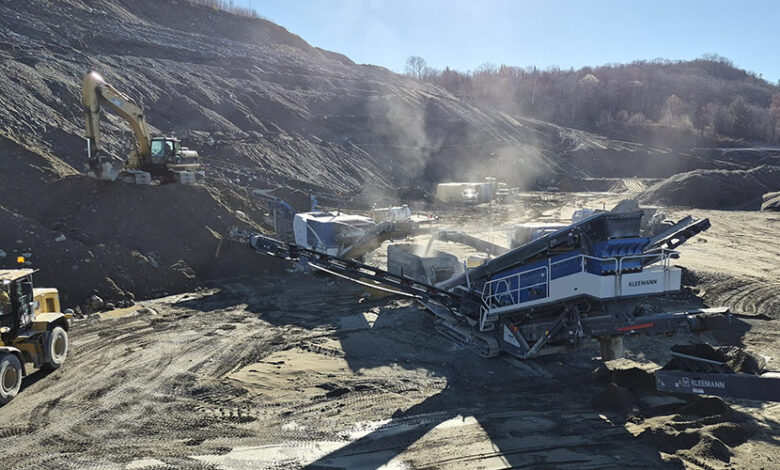
Revitalisation of an Indigenous community in Canada with the aid of advanced Kleemann crushing and screening technology
Within the context of an ongoing infrastructure project, the Garden River First Nation Indigenous community is supplying graded aggregates for the rehabilitation of a 16-kilometre section of Highway 17A. This runs through the reserve and also serves as a bypass for the national Trans-Canada Highway. In order to fulfil demands in terms of tonnage and grain quality, the community has invested in a fleet of Kleemann machines consisting of a MOBICAT MC 110 EVO2 jaw crusher, two MOBICONE MCO 90 EVO2 cone crushers, two MOBISCREEN MSC 953 EVO screening plants and a MOBIBELT stacker. Depending on the final product specifications, the machines work in combination as primary, secondary or tertiary crushing and screening plants.
Aggregate production creates new jobs
Indigenous communities in Canada are vital to the fabric of the nation, preserving Indigenous culture, language and family ties. In some communities, population is dwindling as many band members move to larger centres with more educational opportunities, jobs, and housing. The Garden River 14 reserve region, located around 700 km northwest of Toronto, is known as the Garden River First Nation and has a population of 3,500 band members, just over 1,000 of whom live within the reserve. Of those, 200 are employed by the community itself, 13 of whom are currently employed in the materials processing operation. The aggregates produced are essential for infrastructure construction, and the newly acquired Kleemann plants contribute to the generation of higher revenue and more jobs.
An investment in the future
The resurfacing began in late 2025 and is scheduled for completion in 2028. The project requires close to 100,000 t of aggregate for the base layer, 170,000 t for the subgrade and 100,000 t of asphalt dust and Superpave. The latter is a recently developed, performance-based system for the production of asphalt mixes and selection of suitable road surfacing binders. It is designed to ensure that the paved surface can withstand extreme temperature fluctuations and heavy traffic without any problems. ‘When we became aware that the bypass was going to undergo resurfacing and we were to be partnered into that project, we realised that our old crusher was too outdated and wasn’t capable of producing some of the products like the Superpave,’ recalls Chris Morettin, Business Entities Manager for Garden River First Nation. ‘We needed to replace that model with something brand new that had the capabilities to meet Ontario Ministry of Transportation requirements.’ Morettin and Aggregate Supervisor Travis Belleau decided to invest in a Kleemann plant train. ‘We conducted a financial analysis based on revenues that were going to be generated, and we were able to see that purchasing this equipment would pay for itself over the lifespan of this project,’ says Morettin.
‘Northern Ontario has a lot of hard rock, and the harder the rock, the more damage there is to an impactor. That’s why we typically see a lot of jaw and cone crushers in operation in this region. They’re just more cost effective,’ explains Richard Perzan, Vice President Sales, Construction and Forestry (Central) at Brandt, the local authorised Wirtgen Group dealer in Canada.
Intuitive, safer and versatile
Aside from the low fuel-consumption, Belleau was also particularly impressed by the intuitive operating concept. ‘I haven’t been crushing very long. I found it fairly easy to learn.’ And adds, ‘I think that speaks volumes.’ ‘What I like most is the touch screen, which has tons of information on it. What Belleau also likes is how the touch screen in the SPECTIVE operating concept helps with troubleshooting and fixing problems. ‘Our old machine didn’t have a touch screen, so you would just have to trial-and-error everything. These machines, they can pinpoint what’s wrong, so you’re not just swapping everything out to try and band-aid a problem. You’re able to diagnose it quickly, have the part replaced and then be back up and running as soon as possible. That’s a huge asset’, he emphasises. The crew really appreciates the simple and logical operating concept and the safety functions The plant activates an alarm when there’s a problem and switches itself off. ‘Then all the operator has to do is just walk over to the machine and diagnose the code. The safety factor that is built into the machines has been instrumental to helping us to learn and understand the machines and keep them running longer,’ says Belleau Another advantage is the use of smart line coupling, which also protects the machines. Sensors detect when the cone crusher gets too full and smart line coupling then automatically reduces the speed of the feeding unit of the upstream jaw crusher.
Reinvestment of revenues
The aim of the Garden River First Nation is the reinvestment of the income from the operations to bolster the revitalisation of the community. Last year, the band built 20 new houses and supplied all the aggregates required from their own plant. And, with the opening of several subdivisions, the economic growth continues. ‘That gives us more work for the community and makes it possible for more people to move back,’ says Belleau. The resurfacing of Highway 17A brings jobs not only in materials processing but also in road construction, where machine operators, construction workers, surveyors and other human resources are required.
Further information:
WIRTGEN GROUP
www.wirtgen-group.com