Review // Walter Frenz: Handbook Raw Materials Industry
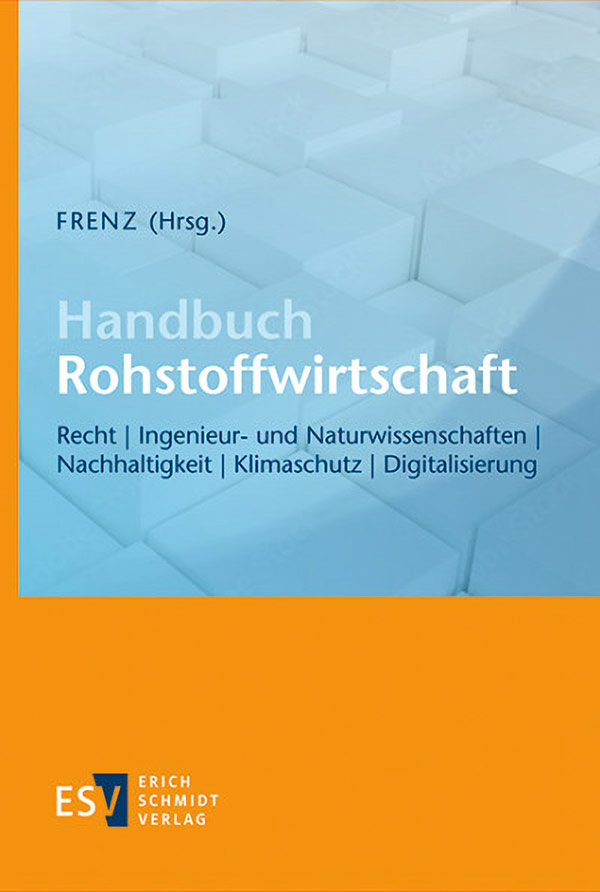
Walter Frenz: Handbuch Rohstoffwirtschaft – Recht, Ingenieur- und Naturwissenschaften, Nachhaltigkeit, Klimaschutz, Digitalisierung (Handbook Raw Materials Industry – Law, Engineering and Natural Sciences, Sustainability, Climate Protection, Digitalisation Reducing Bureaucracy), 1st edition, Year of publication: 2025, Pages: 1145, Publisher: Erich Schmidt Verlag, Language: German, 978-3-503-24213-9 (E-ISBN), 978-3-503-24212-2 (Print ISBN), DOI: 10.37307/b.978-3-503-23745-6.
Once again, Prof. Walter Frenz, Maitre en Droit Public and Professor of Mining, Environmental and European Law at RWTH Aachen University, has edited a comprehensive work, drawing on contributions from numerous authors (69!), at a time of great relevance to the subject of raw materials (published as early as 2025). He has titled it “Handbuch Rohstoffwirtschaft” (Handbook of the Raw Materials Industry). The title alone promises a comprehensive compendium, which is precisely what it is. Following a foreword, the 1145-page volume examines the subject of the raw materials industry across six sections as follows:
- The importance of raw materials
- Domestic raw materials extraction
- Mining law and mining law reform
- Raw material extraction and procurement abroad
- Raw materials internationally and
- EU law on raw materials.
The work is rounded off with an index, which seems particularly helpful given its scope. Equally important is a list of abbreviations, which has been placed at the front of the book alongside the list of authors.
The six parts of the work are clearly organised into various chapters, with the number of the part and the respective chapter listed in the header, so that the reader always knows which aspect of the raw materials economy they are currently reading about.
Part 1 – The Importance of Raw Materials – comprises nine chapters (raw material demand; energy and climate; sustainable use of raw materials in the context of climate protection from a constitutional and European legal perspective; ceramic and mineral raw materials for transformation and climate protection; the future of domestic gypsum supply security; raw material extraction in Germany: an analysis of current and future supplies of domestic raw materials using gypsum as a case study; demand for and availability of stone and earth raw materials; extraction of mineral resources – significance, legal framework and licensing procedures; mining in the circular economy; and, finally, establishing a hydrogen economy in Germany). Chapter 2, “Sustainable use of raw materials in the context of climate protection from a constitutional and European legal perspective”, is presented by the editor himself.
Part 2 – Domestic Raw Material Extraction – is then divided into 14 chapters (the raw materials sector in Germany; the permissibility of routine fitness-for-work assessments in mining employment; automation in mining; digitalisation in mining: data as the basis for the mining industry of the future; digitalisation and artificial intelligence in law; potential for processing and reuse: mining survey data and mining infrastructure in the context of the energy transition; current status and future developments in deep geothermal energy in Germany; minimally invasive mining; current situation and challenges in Rhineland lignite mining against the backdrop of the accelerated phase-out of coal use; opportunities and challenges of post-mining in lignite/coal regions of Germany and India; post-mining in Lusatia; security for corporate post-mining obligations through precautionary agreements and special-purpose vehicles; experiences in the development of a new raw materials project in Saxony; and, finally, public acceptance of the extractive industry: an analysis of the status quo and communicative approaches to solutions). In this section too, the editor himself addresses a topic in Chapter 14, “Digitalisation and artificial intelligence in law”.
Part 3 – Mining Law and Mining Law Reform – comprises six chapters covering the following topics: the fundamentals of German mining law; perspectives on mining law and limited reform; mining law authorisation procedures in theory and practice; mining and nature conservation law; mining and water law; and post-mining activities within the framework of mining and water law. In this part, too, Frenz personally contributes the chapters “Prospects for mining law and limited reform” and “Mining law and nature conservation law”, subjects with which he is thoroughly familiar.
In the following Part 4 – Raw Material Extraction and Procurement Abroad – the chapters cover raw materials for Germany: an overview of the situation, promotion of domestic raw material extraction and overseas mining, state of mining in the United States, mining in Brazil, mining in Colombia, the People’s Republic of China as a target country for raw materials – inbound/outbound, rare earth mining in Mongolia, and geology, mining and mineral beneficiation in southern Africa: major minerals, challenges and opportunities across more than 230 pages.
In this part, four chapters are printed in English (as is the case with one chapter in Part 2), which does not detract from the content but does, to some extent, hinder the smooth readability of the work and its overall presentation.
Finally, there are two further parts covering the topics “Raw materials internationally” and “EU law on raw materials”. The first part comprises three chapters entitled “Blue mining”, “Raw material access claims and consequences for domestic raw material extraction” and “International standardisation work in the field of abandoned and post-mining sites”. The concluding Part 6 comprises two chapters entitled “EU raw materials security: CRMA and strengthening competitiveness” and “The EU Critical Raw Materials Act (CRMA) – origins and analysis of its feasibility”. Frenz has written one chapter in each of these parts.
Conclusion: The subject of the raw materials economy and the recently reignited global struggle for raw materials is comprehensively examined in this work by the editor and the renowned authors. The book was published in 2025 and is therefore highly topical both at that time and to this day. Perhaps it was published a little too early to be able to incorporate experience regarding the application, the application process and the handling of the Critical Raw Materials Act (CRMA) in relation to German raw materials projects. Nevertheless, the editor, Walter Frenz, deserves credit for his comprehensive presentation, and the numerous authors for their thorough treatment of the subject of the raw materials economy.
The fact that a comprehensive account of all subtopics is not possible stems from the dynamic nature of issues such as mining law and mining law reform, licensing procedures, domestic raw materials extraction and raw materials procurement.
All in all, this book is a worthwhile reference work and offers the reader an overview of the importance of raw materials, the state of the German mining industry – including domestic raw material extraction as well as legacy and post-mining operations – at the present time.
Dipl.-Geol. Olaf Alisch
Editorial Team
Mining Report Glückauf, Essen