New process enables almost perfect digital twins of RAG sites
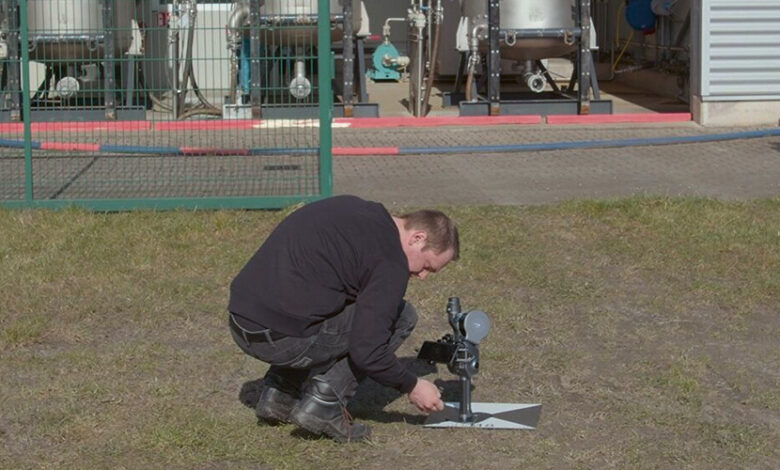
Using a new scanner, RAG’s geomonitoring team can generate highly accurate 3D models in no time at all using Gaussian splatting – mobile and with impressive depth of detail. In future, other departments within the company will also be able to use the equipment for surveys, enabling them to create digital twins on which some work steps can be carried out virtually. There are already many ideas for specific applications.
The new device – a Lixel L2 Pro from XGrids – is equipped with three powerful panoramic cameras, a 3D laser scanner and a GPS antenna, among other features (Figure 4). It has a range of up to 120 m and the data is automatically georeferenced. “A walk-through with the scanner in hand is enough to capture extensive figure and scan data in just a few minutes,” explains Andreas Schlienkamp, head of the geomonitoring team at RAG.
The scan data is then processed on the geomonitoring computers. Within one to two hours, a near-perfect digital twin is created. This is made possible by the use of the “Gaussian splatting” process, which has only become practical thanks to rapid developments in the field of artificial intelligence and graphics chips. The 3D models allow virtual tours of the photorealistic environment as well as precise measurements of individual plant components or construction site areas. In future, the scans can also be easily combined with classic survey points and historical data.
“After a brief introduction, the scanner is so easy to use that in future, all departments will be able to borrow the device for upcoming surveys and use it independently,” promises Schlienkamp. The geomonitoring team then processes the data and provides the finished 3D models.
During the test phase, many possible applications emerged in discussions with other departments within the company. Here are a few examples:
- General documentation of facilities such as groundwater purification plants or mine water locations;
- conditions at remediation sites for sinkholes, such as possible traffic routes for heavy equipment;
- conditions at gas drilling sites;
- planning of (new) construction measures at sites;
- representation of sites for communication purposes as an alternative to drone images; and
- recording of individual facilities for training purposes for new employees.
According to some RAG departments, the 3D models provide such a detailed visual impression that, once they have been captured, a number of on-site visits can be saved in future. This applies both internally and externally, as it would also be conceivable to make the virtual twins available to external service providers so that necessary measurements, e. g., can be carried out virtually. In view of the great potential, RAG is already considering purchasing additional scanners, according to Schlienkamp.
The experience with “Gaussian splatting” is also meeting with great interest outside the company: RAG has been invited to provide information on the practical applications of the process in the “Statewide Digital Twins” network group. Esri, the market leader in geographic information system (GIS) software, has already sought information from RAG. Emschergenossenschaft and Lippeverband (EGLV) were also enthusiastic about the possibilities. Other companies have expressed interest in an exchange.
Gaussian splatting is a 3D visualisation technique that uses small, overlapping 3D ellipses called “splats” instead of traditional points or polygons. These splats contain information such as position, colour and transparency. The arrangement of millions of these splats creates a volumetric image of reality that enables particularly realistic representations in virtual reality applications. The process is efficient because it requires less memory and allows for faster processing of large amounts of data. (RAG /Si.)