The final breakthrough has been achieved

A milestone in mine drainage at Ibbenbüren was celebrated in style.
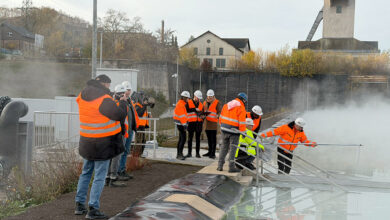
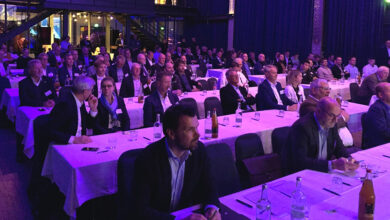
The tunnel boring machine, christened “Tisa”, used for the eastern section of the Ibbenbüren mine drainage canal, has reached its final destination: Shaft 1 of the von-Oeynhausen mine. This marks the completion of the 7.4 km-long mine water canal after around 26 months of construction. The excavation of the canal has now been completed. In future, mine water from the eastern and western fields of the Ibbenbüren mine will be channelled through the canal to the new mine water treatment plant currently under construction in Gravenhorst. This was celebrated on 24 February 2026 with a ‘breakthrough ceremony’.

Jürgen Kunz, Head of the RAG’s Ibbenbüren Business Unit, explained at the start that initial ideas for the Ibbenbüren mine water canal had been considered as long as ten years ago. Kunz: “In autumn 2014, the first presentations were made outlining the basic considerations for the excavation of the mine water canal as an alternative to a pumping solution. Today we are gathered here to mark the final milestone in the tunnelling work.” He welcomed the mayors of the mining region, representatives of the Arnsberg district government, the participating companies, as well as representatives of the RAG-Stiftung and RAG.

Since the end of German hard coal production, pumping mine water has been one of the tasks left behind by the mining industry, emphasised Bernd Tönjes, Chairman of the Board of the RAG-Stiftung, in his welcoming address. The RAG-Stiftung was established in 2007 to provide long-term funding for these perpetual tasks. Tönjes: “But what we would prefer to do even more than pumping is not to pump. And that is where it is possible.” And in Ibbenbüren, this is feasible due to the favourable topographical and geological conditions.
This is because the mine water channel allows the mine water to rise to 63 m above sea level. As a result, just as in Westfeld, pumps can be dispensed with. Tönjes: “This means significant savings in costs, energy and CO₂ emissions. Furthermore, the constituents of the mine water are significantly reduced.” So this is the best solution for managing mine water for people, drinking water and the environment.

The excavation of the mine water canal was not an off-the-shelf project, emphasised RAG CEO Peter Schrimpf: “We all had to learn as we went along and adapt to a wide variety of conditions.” For example, both tunnel boring machines and the team had to cope with constantly changing geological conditions. Schrimpf: “Lots of water, little water, high water pressure, low water pressure, rock that was hard at times, soft at others. There was a bit of everything. It does get a bit gloomy in front of the cutter from time to time. Even at this depth.” That is why today is such a memorable moment for everyone, emphasised the RAG CEO. “A moment for which I would like to express my special thanks to everyone involved.”
There is still a lot to be done. From now on, the focus is on the complete expansion of the tunnel, before the mine water from the East Field, according to current forecasts, reaches the level of the canal in 2026 and flows into it. Through the canal, the mine water from the West and East Fields is channelled separately into the new mine water treatment plant in Gravenhorst, where it is then treated in an environmentally sound manner.
Schrimpf: “Here in the Tecklenburg region, we are demonstrating that we can start receiving mine water in record time following the closure of a mine. And here at this site, we are showing that we are not just capable of hard coal mining. We are also experts in post-mining – with innovative and sustainable solutions. An important and reliable partner for this region – that is what we want to remain in the future.” (RAG/WK)