


Joint Storage of Lithium-Ion Batteries and Oxygen Self-Rescuers – Recommendations for Safe Operation
Author: Tim Kuhne, Advisor in the Fire Safety Unit of the Emergency Management Prevention Department at the German Social Accident Insurance Institution for the Raw Materials and Chemical Industry (BG RCI), Heidelberg/Germany, and Head of the Workplace Fire Safety Section at the German Social Accident Insurance (DGUV), Berlin/Germany)
DOI: 10.66356/mrg.2026.03.04.ENJSLIB
Lithium-ion batteries (LIBs) and oxygen self-rescuers (SSRs) are standard equipment, particularly in the mining industry. Both product groups are frequently made available to staff in lamp rooms, equipment issue points and charging areas in close proximity for collection at the start of a shift. This brings together different hazard mechanisms: in the event of a fault, LIBs can lead to thermal runaway, resulting in fire and the release of hazardous fumes. SSRs release chemically bound oxygen and may therefore support or intensify combustion.
The DGUV Fachbereich AKTUELL FBFHB-039 technical publication, published in December 2025 under the title “Joint Storage of Lithium-Ion Batteries and Oxygen Self-Rescuers”, assesses joint storage in the context of TRGS (Technical Rules for Hazardous Substances) 510 “Storage of hazardous substances in portable containers”. It describes practical measures ranging from the separate storage of certain SSR categories and structural or spatial separation to technical solutions for charging areas.
1 Introduction
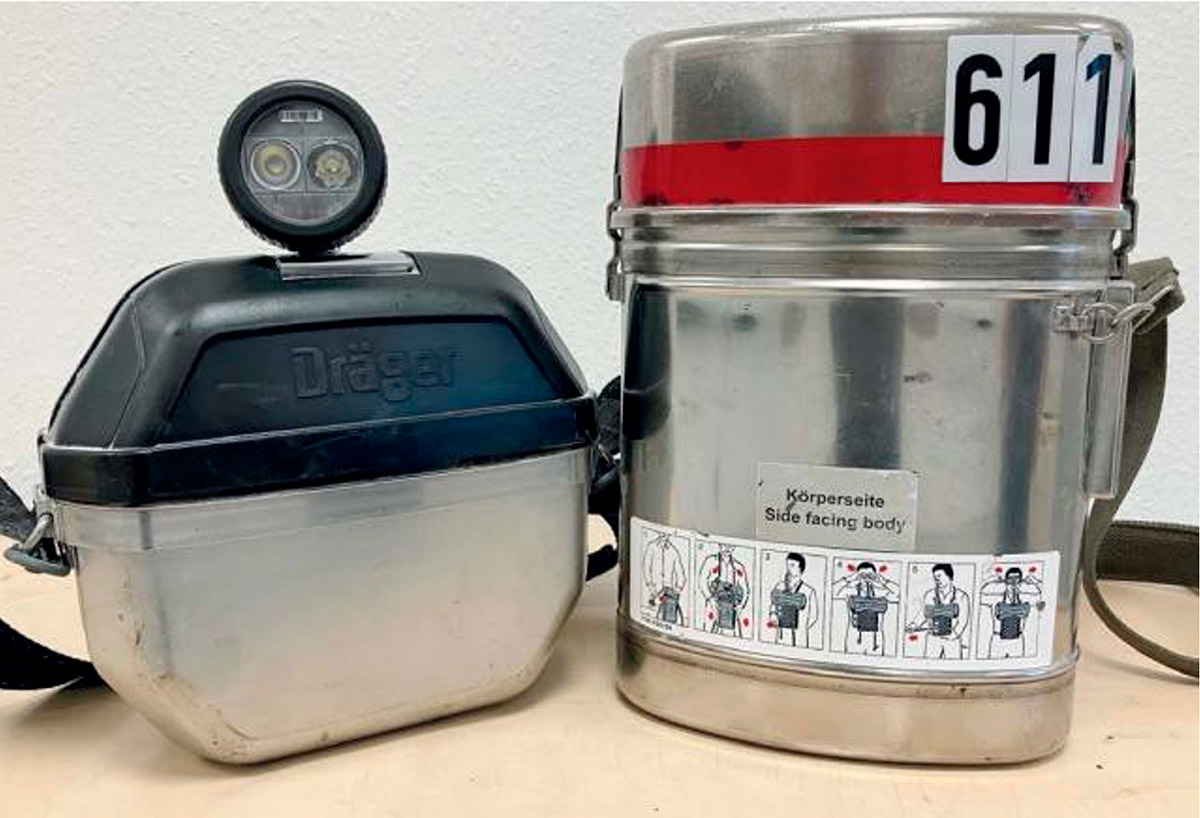
In lamp rooms, equipment issue points and charging areas, storage within the workplace is often organised pragmatically. Items required during shift work need to be readily available and are therefore kept close together. In practice, this is where cap lamps with lithium-ion batteries (LIB) and oxygen self-rescuers (SSR) are often stored together (Figure 1).
At the same time, incidents involving LIBs differ significantly from conventional incipient fires. Defects, damage or charging problems can lead to dynamic fire behaviour and the release of hazardous smoke gases. If oxidising substances or oxygen released from oxygen self-rescuers are also present, the fire may intensify further.
Against this background, the question is not so much whether LIBs and SSRs are present in the workplace, but rather how storage and charging can be organised in such a way that work processes run smoothly whilst robust protective barriers remain effective.
For this reason, the Workplace Fire Safety Section of the German Social Accident Insurance (DGUV), in collaboration with experts, prepared a technical publication that provides organisations with clear guidance on the requirements set out in current regulations and the risk-reduction measures that may be considered. This technical article presents the key points of DGUV Fachbereich AKTUELL FBFHB-039 and places them in the context of workplace practice.
2 Hazards and regulatory classification
LIBs can undergo thermal runaway in the event of malfunction or damage. This can lead to the development of a fire as well as the release of toxic and corrosive gases. SSRs release chemically bound oxygen and may therefore support or intensify combustion. In the case of damaged chemical oxygen self-rescuers, such as KO2-based SSRs, moisture – for example, from fire-fighting water or extinguishing foam – may penetrate the reaction material. This can contribute to additional heat generation and exacerbate the situation. For operations, this means that in areas where LIBs and SSRs are stored together, consideration should be given not only to the outbreak of fire but also to the potential intensification of a fire and the associated hazards, such as the generation of large quantities of smoke.
The obligation to systematically assess working conditions and to establish appropriate protective measures is laid down in both general occupational safety and health law and mining law. However, for operations subject to mining law, the German Occupational Safety and Health Act (ArbSchG) and the German Hazardous Substances Ordinance (GefStoffV) do not apply without restriction. Their provisions do not apply to the extent that corresponding requirements are contained in mining legislation.
With regard to the specific issue of the joint storage of LIBs and SSRs, mining law generally does not contain detailed provisions directly comparable to those provided by hazardous substances legislation. Against this background, the mining company is responsible for assessing, on the basis of Section 2(1) and (2) of the General Federal Mining Ordinance (ABBergV) and taking into account the requirements of hazardous substances legislation, whether use at the intended location is compatible with the safety and health objectives for employees.
For this reason, the underlying technical publication has drawn on TRGS (Technical Rules for Hazardous Substances) 510 and DGUV Information 205-041 as technical assessment criteria, even though these do not have direct legal effect for operations subject to mining law. TRGS 510 sets out recognised requirements for the storage of hazardous substances in portable containers and uses storage classes to determine whether joint storage is permitted or prohibited. In addition, the relevant guidance in DGUV Information 205-041 “Fire protection when handling lithium-ion batteries” is taken into account for the assessment of the storage and charging of LIBs.
According to the manufacturer’s specifications, SSRs are classified under either storage class 5.1 A (H271, strongly oxidising) or 5.1 B (H272, oxidising) in accordance with TRGS 510. This classification gives rise to quantity thresholds above which additional or special measures become necessary. For LIBs, the new technical publication refers to DGUV Information 205-041 and specifies practical storage conditions, including cool, dry and frost-free storage, as well as a typical state of charge of 40 to 60 %. Devices showing signs of damage or subject to mechanical stress must be stored and charged separately. Furthermore, in the context of TRGS 510, LIBs are regarded as potential ignition sources, which must be taken into account when storing them together with other substances. It is also important to observe the manufacturers’ instructions for the respective battery-powered devices in use.
Notwithstanding these rules and guidelines, organisations may, as part of a thorough assessment of working conditions, implement alternative measures provided that these achieve at least an equivalent level of protection. For organisations operating under mining legislation, early consultation with the relevant authority, in conjunction with appropriate expert bodies, is recommended.
3 Joint storage of SSRs and LIBs in practice
In many organisations, the discussion boils down to a simple question: Can these be stored together?
The technical publication DGUV Fachbereich AKTUELL FBFHB-039 answers this question by referring to the SSR category and the storage classes set out in TRGS 510, supplemented by guidance from DGUV Information 205-041.
3.1 Classification, Assignment and Joint Storage of LIBs and SSRs in Accordance with TRGS 510
TRGS 510 does not provide a definitive assignment of LIBs to a storage class (LGK). Some manufacturers classify LIBs as LGK 11 (combustible solids). As LIBs are also regarded as potential ignition sources, the potential hazard is generally increased. LGK 11 is therefore taken as a reference for further consideration. DGUV Information 205-041 also points out that joint storage with hazardous substances and flammable substances must be avoided.
Compared with LIBs, the assignment of SSRs to storage classes under TRGS 510 is clear. The storage class specified by the manufacturer is decisive.
According to the joint storage table, and as illustrated in Figure 2, joint storage of SSRs assigned to LGK 5.1 A (Category 1, H271) with LIBs (reference classification: LGK 11) is not permitted. For SSRs assigned to LGK 5.1 B (Categories 2 and 3, H272), joint storage may be possible under certain conditions. As an orientation value, the total quantity in the storage room should be less than 1,000 kg; this quantity is often not reached in practice.
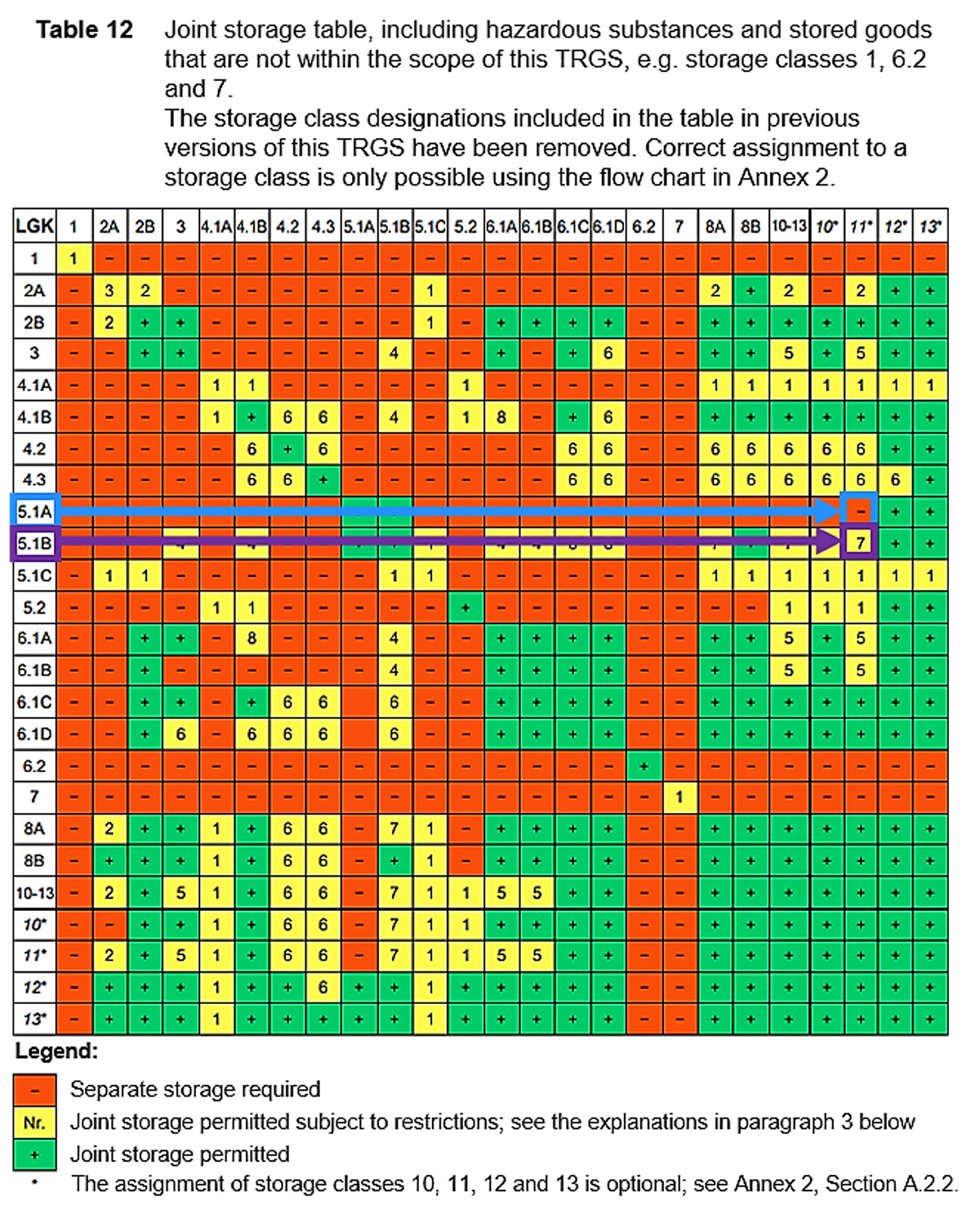
This makes it clear that the decision on joint storage should not be made “on a hunch”. It depends on the manufacturer’s classification, quantities and the specific storage environment, and must be justified in a transparent manner as part of the company’s assessment of working conditions.
3.2 Requirements for the general storage of SSRs
Irrespective of the issue of joint storage, TRGS 510 stipulates that additional or special measures are required once certain quantity thresholds are exceeded.
According to the safety data sheets of various manufacturers, the mass of potassium superoxide (KO2) used in chemical oxygen self-rescuers typically ranges from approximately 0.5 kg to around 1 kg per unit, depending on the rated duration. The exact fill quantity is manufacturer-specific and should be verified on a case-by-case basis using the technical documentation or safety data sheets.
For Category 1 SSRs (H271), TRGS 510 stipulates that additional measures apply as soon as the total quantity of the oxidising substance in storage exceeds 1 kg. The total mass contained in all units stored within the relevant room must be taken into account. From 5 kg onwards, storage rooms must be separated from adjacent areas by fire-retardant barriers. In addition, an emergency plan must be drawn up and displayed in a clearly visible location. If the stored quantity exceeds 200 kg, further structural requirements must be implemented. These include, amongst other things, separate storage sections from other areas. Furthermore, storage must be restricted to single-storey buildings or appropriate storage areas.
Higher thresholds apply to SSRs in Categories 2 and 3 (H272). Additional measures apply from 50 kg, and special measures from 200 kg. If these limits are exceeded, the further protective measures must be applied accordingly.
It is particularly recommended that businesses examine TRGS 510 in detail so that the areas where SSRs are stored and the associated hazards can be adequately assessed.
3.3 Requirements for charging LIBs
The charging of LIBs must be considered separately, as additional sources of error and thermal stresses may arise. In particular, charging should take place:
- on a non-combustible surface; and
- where possible, under supervision.
If direct supervision is not possible, monitoring by fire detectors connected to a fire alarm system or charging in a room separated by fire-resisting construction may be considered. The manufacturers’ specifications must also be taken into account.
4 Practical options for implementing structural and technical protective measures
For technical implementation, the DGUV Fachbereich AKTUELL FBFHB-039 technical publication describes a phased approach that can be adapted to suit the specific situation.
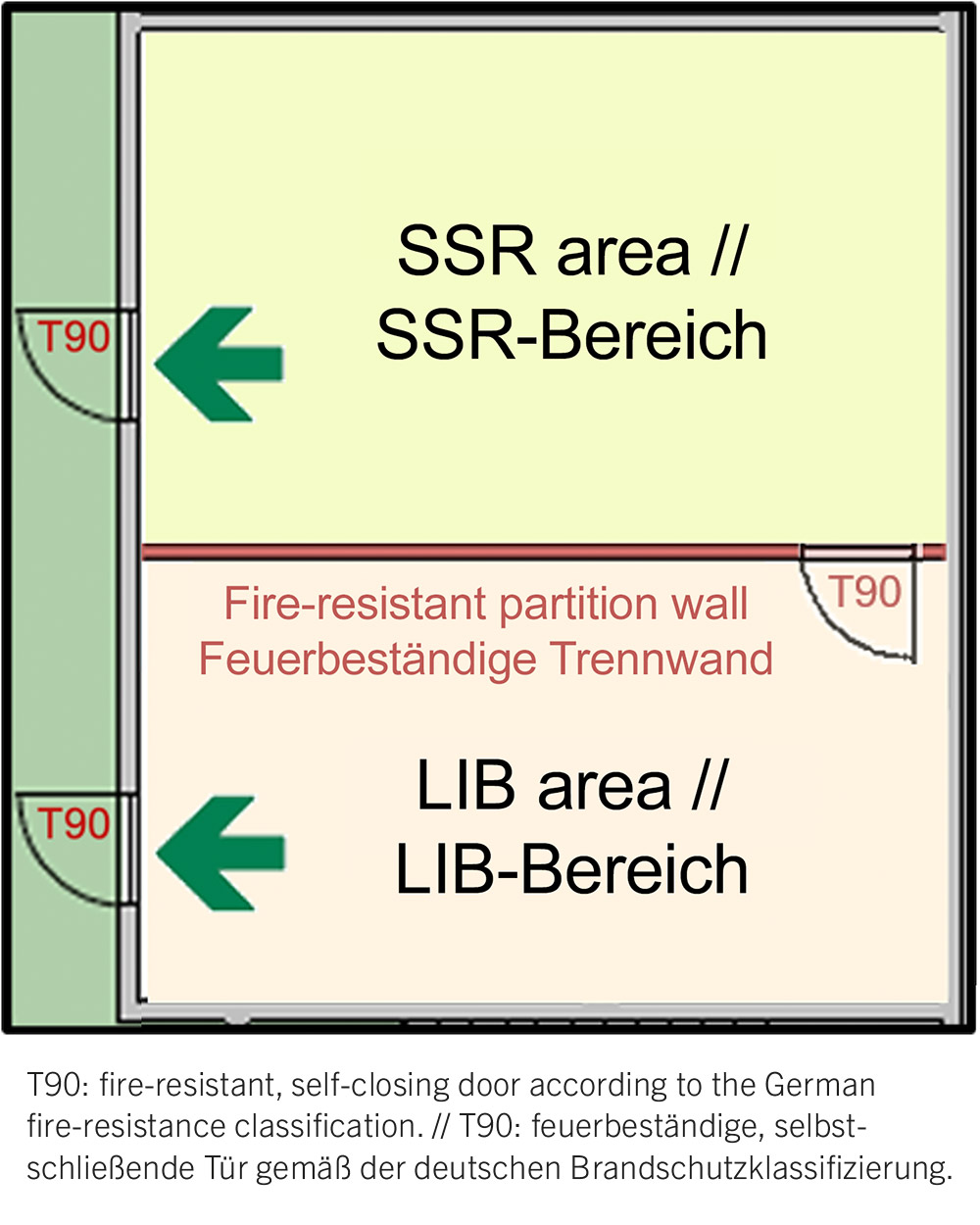
In many mining operations, lamp rooms and equipment issue points are located within structures that have evolved over time. Complete structural separation is therefore not always readily achievable. However, if separate storage is required for SSRs assigned to LGK 5.1 A, structural separation should be given priority consideration. The aim should be to create separate storage sections that reliably prevent the spread of heat, flames or smoke in the event of a fire. Fire-resistant partition walls, in conjunction with fire-resistant, self-closing doors, can form an effective barrier in this regard (Figure 3).
Particularly in areas with large numbers of employees and regular shift changes, such a structural solution makes an important contribution to minimising the risk of fire spreading to stored oxygen self-rescuers.
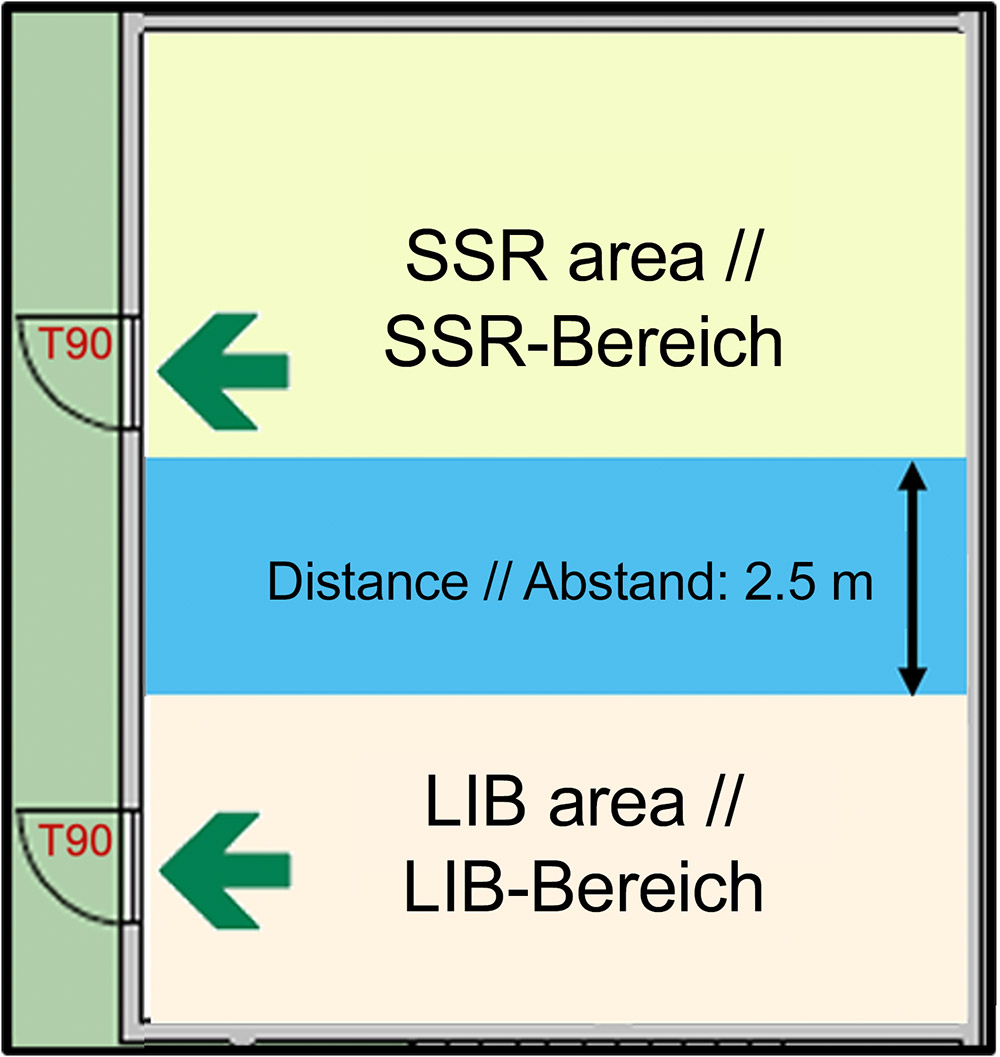
Where existing building or room structures do not permit structural separation, spatial separation within the same room may represent a viable alternative (Figure 4). Technical publication DGUV Fachbereich AKTUELL FBFHB-039 specifies a horizontal distance of at least 2.5 m as a reference value for this purpose. This value is based on recommendations relating to lithium-ion batteries and can also be used as a suitable guideline in the context of the joint storage of LIBs and SSRs. In practice, this means arranging charging areas and storage locations in such a way that direct thermal impact on adjacent SSRs is avoided as far as possible by maintaining sufficient distance.
If neither structural nor spatial separation can be achieved, technical solutions are proposed. One such solution mentioned is the use of an automatic fire-extinguishing system, the design of which must be carried out by specialist engineers. In the case of continuous charging operations, an automatic fire alarm system is also recommended, which can, for example, alert the fire service in the event of a fire. Multi-sensor detectors incorporating smoke and heat sensors are described as a detection solution.
In the event of an incident, both smoke development and rapid temperature changes should be detected at an early stage. If defined thresholds are exceeded, the charging process should be shut down and a notification sent to a continuously staffed location. The decisive factor is not a single numerical criterion, but transparent, risk-based planning within the framework of the operational assessment of working conditions.
The measures outlined are practical proposed solutions that are consistent with current regulations, information and specialist publications. Other protective measures may also be considered, provided they achieve at least the same level of protection. For operations subject to mining law, the selection of solutions should be carried out in close consultation with the relevant authorities.
5 Organisation, training and follow-up
Technical measures are only reliable if they are supported by organisational measures. Recommended measures include instructing employees, keeping the affected area free of additional fire loads, involving a fire safety officer in accordance with DGUV Information 205-003; where appropriate, expert support should be sought for planning and implementation.
The selected protective measures must be documented and regularly reviewed for effectiveness. Furthermore, professional fire-damage remediation is essential following a fire incident.
6 Summary
DGUV Fachbereich AKTUELL FBFHB-039 provides a practical decision-making framework for workplaces. The decisive factors are the manufacturer’s classification of oxygen self-rescuers into storage classes, the quantities present, and the specific layout of storage and charging areas.
For SSRs in storage class 5.1 A, joint storage with LIBs is not permitted under TRGS 510. In such cases, separate storage sections with effective separation are required. For SSRs in storage class 5.1 B, joint storage may be possible under strict conditions, provided that quantity thresholds are adhered to and additional fire loads in the storage section are avoided.
Irrespective of this, the charging of LIBs should be regarded as a separate risk factor and underpinned by technical and organisational protective barriers.
References / Quellenverzeichnis
[2] DGUV Information 205-041 „Brandschutz beim Umgang mit Lithium-Ionen-Batterien“ [Fire protection when handling lithium-ion batteries].
[3 ] DGUV Fachbereich AKTUELL FBFHB-039 „Zusammenlagerung von Lithium-Ionen-Batterien und Sauerstoffselbstrettern“ [Joint storage of lithium-ion batteries and oxygen self-rescuers].
Author: Tim Kuhne, Advisor in the Fire Safety Unit of the Emergency Management Prevention Department at the German Social Accident Insurance Institution for the Raw Materials and Chemical Industry (BG RCI), Heidelberg/Germany, and Head of the Workplace Fire Safety Section at the German Social Accident Insurance (DGUV), Berlin/Germany)
DOI: 10.66356/mrg.2026.03.04.ENJSLIB
